
OM4 vs OM5: Choosing Multimode Fiber for 100G and Beyond
Wavelength-division multimode, SWDM4 readiness and where OM5 actually pays for itself in short-reach 100G and 400G links.
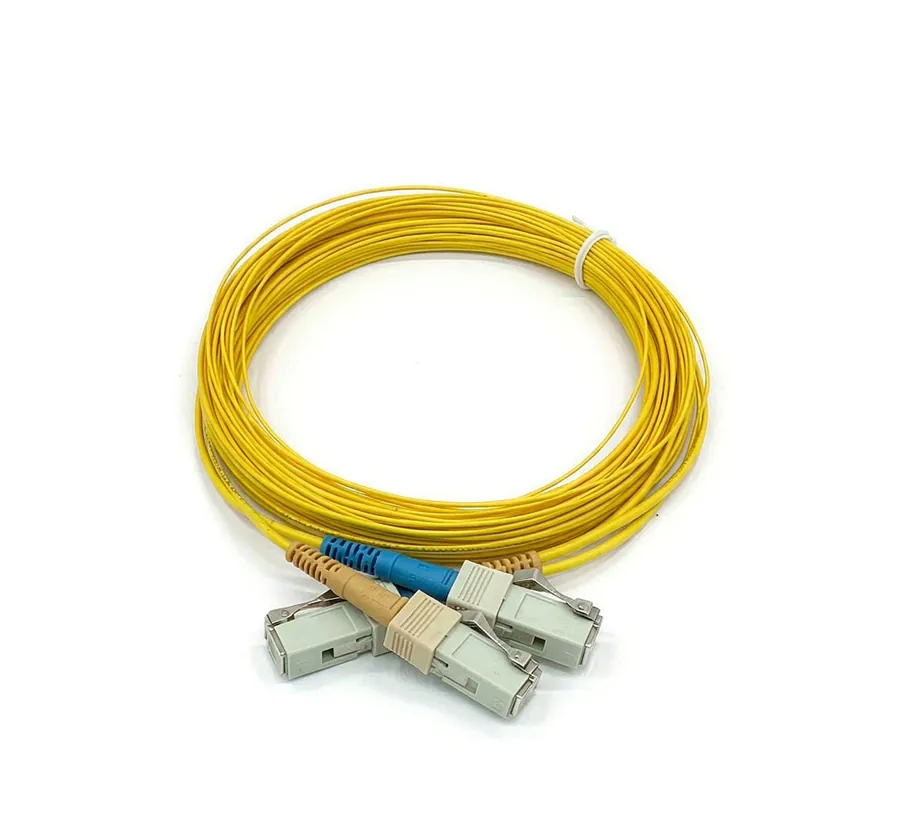
OM4 has been the default multimode grade for 10G to 100G links for more than a decade. OM5 looks almost identical — same 50/125µm core, same LC and MPO connectors, same lime-green jacket — but it adds a specification that OM4 does not have: bandwidth at 850 nm plus 880 nm and 910 nm.
What OM5 adds
OM5, standardised as TIA-492AAAE and IEC 60793-2-10 type A1a.3, guarantees an effective modal bandwidth of 4700 MHz·km at 953 nm in addition to the OM4 figures at 850 nm. That extra window is what makes shortwave wavelength division multiplexing (SWDM) practical: four wavelengths between 850 and 953 nm can run over a single multimode pair.
Reach and cost comparison
- 10G / 25G: OM4 already reaches 400 m and 100 m respectively. OM5 offers no practical advantage.
- 40G / 100G: Both grades reach 150 m and 100 m with MPO parallel optics. OM5 helps only when you plan to migrate those links to SWDM4.
- 200G / 400G: Short-reach multimode modules are specified against OM4 as a minimum. OM5 gives headroom for SWDM and for older, higher-loss plants.
- Cost: OM5 typically carries a 20–40% premium on cable and patch cords, and both need the same MPO polishing and test routine.
When OM4 is the right answer
If your design uses parallel optics at 850 nm — 40GBASE-SR4, 100GBASE-SR4, 200GBASE-SR4, 400GBASE-SR8 — OM4 meets the standard at every reach you are likely to build inside a building. The money is better spent on better test coverage and on cleaning and inspection tooling, which affect real link performance far more than the grade printed on the jacket.
When OM5 pays off
OM5 makes sense when a single pair must carry aggregated capacity — for example a SWDM4 100G link over one duplex LC run in an existing duct that cannot take a new MPO trunk. It is also a reasonable future-proofing choice for greenfield buildings where re-cabling later would be disruptive.
Practical advice
Do not mix grades inside one channel. A link budget computed for OM5 will not be met if half the run is OM4, and the loss budget is what the transceiver actually sees. Keep OM4 and OM5 physically separated in the patch panel and label them, and if you do standardise on OM5, standardise on the connectors and the test limit at the same time.


